Why Is My Water Bill So High All of a Sudden
A sudden water bill spike in Wellington almost always means a hidden leak. Here are the seven causes we find most, plus how to test your own meter tonight.
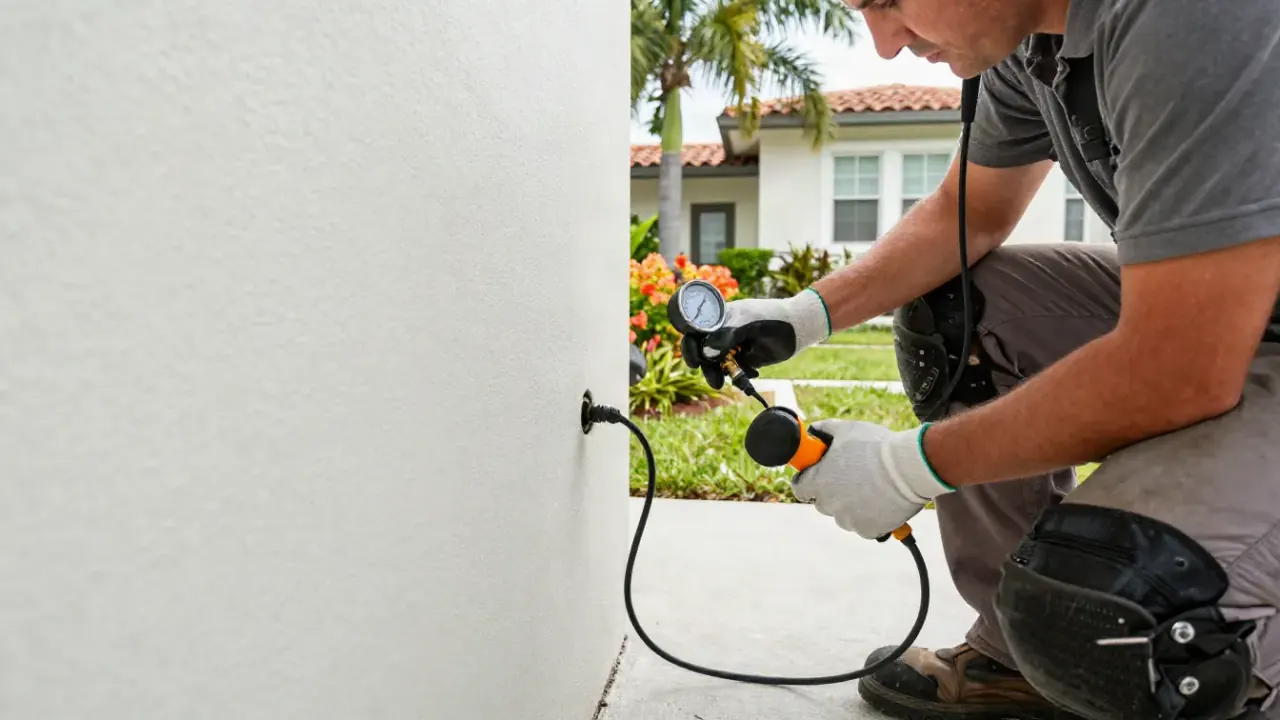
A sudden jump in your water bill in Wellington almost always means water is escaping somewhere between the meter and your fixtures - not that the utility raised rates. If your usage doubled but your habits did not, you have a leak, and most of the time it is on the irrigation line, the pool, or a slab pipe under the house. The rest of this post walks through how to confirm it yourself tonight, the seven causes we find most often in Wellington, and what a real leak is costing you every month you wait.
Why is my water bill so high all of a sudden in Wellington FL is one of the most common calls we get, and the answer is usually findable in about fifteen minutes with nothing more than a flashlight and your meter box.
The Short Answer: A Spike Almost Always Means a Leak
A sudden high water bill in Wellington is a usage problem, not a rate problem - Wellington's utility rates have not jumped enough in one billing cycle to double a normal household bill. Water bill spike reasons in Wellington, Florida almost always trace back to a continuous flow somewhere on the property that runs 24 hours a day, seven days a week.
Here is the math that matters. A single toilet flapper that fails to seal can pass 200 gallons a day. That is 6,000 gallons in a 30-day cycle - roughly the usage of a second family living in your house. An irrigation zone with a broken head can push 15 to 20 gallons per minute, which is 900 gallons an hour if the controller keeps running that zone.
A water bill spike is the symptom. The leak is the disease. Treating the symptom means calling the utility to argue about the bill. Treating the disease means finding the water and stopping it.
How to Test Your Own Meter in 15 Minutes
You can confirm a leak without any tools beyond a flashlight, and you should do this before you call anyone. The test takes about fifteen minutes and it tells you whether the problem is inside the house or out on the property.
- Shut off every fixture in the house - no faucets, no ice maker, no pool autofill, no irrigation running.
- Find your meter box, usually near the street under a rectangular lid. Lift it and locate the small triangular dial or the low-flow indicator.
- Watch that dial for two full minutes. If it spins, water is moving. If it is still, you are not leaking at that moment.
- Write down the main dial reading, wait one hour without using any water, and read it again. Any change at all is a leak.
If the dial spins with everything off, the next step is isolating the house from the yard. Close the main shutoff valve at the house - usually where the service line enters the wall or in a garage utility closet. If the meter stops spinning with the house valve closed, the leak is on the service line or in the yard. If it keeps spinning, the leak is inside the house.
That single test tells our technicians where to start before we ever pull equipment out of the truck. If you want a trained set of eyes on it, our high water bill leak detection Wellington FL service starts with exactly this isolation process, then narrows it down with acoustic and thermal gear.
The 7 Causes We Find Most in Wellington Homes
Common causes of high water bills in Wellington homes fall into seven categories, and we can usually guess which one you have based on the neighborhood and the age of the house. Here they are, roughly in order of how often we find them.
1. Irrigation and sprinkler line breaks
This is the number one culprit in Wellington, and it is not close. Our sandy soil and heavy summer rain shift lines, and a single cracked lateral or stuck valve can run for weeks before anyone notices a wet patch. If your controller runs four zones at 20 minutes each, one stuck zone adds 400 gallons per cycle - and most controllers run three cycles a week.
We trace these with acoustic listening and line pressure testing rather than digging up the whole yard. If your zones are older than ten years, sprinkler leak detection Wellington is worth doing even before the bill spikes, because the failure is coming either way.
2. Toilet flappers and fill valves
A worn flapper is the cheapest leak to fix and the most expensive to ignore. You can test it in 30 seconds: put a few drops of food coloring in the tank, wait ten minutes, and look in the bowl. Color in the bowl means the flapper is passing water. A $15 flapper beats a $200 water bill every time.
3. Pool and spa autofill leaks
Pool autofill valves hide leaks beautifully because the pool never looks low. If your autofill runs constantly and your bill jumped, the pool is losing water somewhere - a cracked skimmer, a failed light niche, or a return line under the deck. We see this constantly in the equestrian communities, where pools and spas sit on larger lots with longer plumbing runs. Homeowners across Equestrian Club Leak Detection deal with this more than most because the pool equipment pads sit far from the pool itself.
4. Slab leaks under the foundation
A slab leak is a hot or cold water line under your concrete foundation that has developed a pinhole or a joint failure. Wellington's soil shifts between wet season and dry season, and that movement stresses copper and CPVC lines. The tell is often a warm spot on the floor, the sound of running water when nothing is on, or a bill that climbs steadily rather than jumping all at once.
Finding one without tearing up the floor takes electronic amplification and thermal imaging. Our slab leak detection Wellington work pinpoints the break to within a few inches so the repair is a small cut, not a demolition.
5. Water service line leaks between the meter and the house
The service line runs from the meter at the street to the shutoff at your house. When it fails, you get a permanently wet strip of grass, a spinning meter with the house valve closed, and a bill that never comes back down. These are common on lots built in the 1980s and 1990s where the original polybutylene or copper line has finally given out.
6. Water softener and reverse osmosis discharge
Water treatment equipment regenerates on a timer, and a stuck regeneration valve can dump hundreds of gallons down the drain every night while you sleep. If your softener cycles at 2 a.m. and your bill doubled, put this on the list.
7. A running toilet you have not noticed
We list this separately from flappers because sometimes the fill valve itself is the problem, or the flapper chain is catching and holding the flapper open. Either way, a toilet that hisses for ten seconds after every flush is telling you something.
Why Wellington's Water and Soil Make This Worse
Wellington's water chemistry and soil conditions make certain leaks more likely here than in most of South Florida. Our municipal supply runs hard - high in calcium and magnesium - which scales the inside of copper lines and accelerates pitting at joints. That is a slow process, but it is why slab leaks show up in houses that are 20 to 30 years old rather than 50.
The soil matters just as much. We sit on a mix of sand and muck that swells when the summer rains arrive and shrinks through the dry months. That cycle flexes buried pipe every year. Irrigation lines, service lines, and pool plumbing all take that movement, and eventually a joint gives.
Add the seasonal usage swing - irrigation running hard from April through October, then backing off - and you get bills that look erratic even when nothing is wrong. The way to tell the difference is the meter test above. If the meter spins with everything off, the season is not the explanation.
We work across the whole village, from the older established streets to the newer gated communities, and the pattern holds everywhere. Homeowners in Olympia Leak Detection see the same irrigation and pool issues we find in neighborhoods built twenty years earlier - the soil does not care how new the house is.
What a Leak Is Actually Costing You Each Month
A hidden leak costs you money every single day it runs, and the number is bigger than most homeowners expect. Typical 2026 pricing in this area puts a mid-size residential leak investigation at $250 to $450, and the repair itself often lands between $300 and $900 depending on what has to be opened up.
Compare that to the bill. A toilet flapper passing 200 gallons a day adds roughly 6,000 gallons to your monthly usage. At Wellington-area rates, that is often $60 to $120 a month on top of your normal bill - and it does not stop until you fix it. An irrigation break running 15 gallons a minute for two hours a day adds 900 gallons a day, which is closer to $200 a month.
A slab leak is the expensive one. It runs continuously, so it can add 10,000 to 20,000 gallons a month, and it also risks damage to flooring, baseboards, and the foundation itself. Waiting three months to investigate a slab leak can cost more in water and repairs than the detection and fix combined.
Most homeowners insurance policies in Florida cover sudden and accidental water damage but not the leak repair itself, and they generally will not cover the water bill. That is another reason to find it fast rather than let it run while you decide.
Common Mistakes Homeowners Make With a High Bill
The mistakes we see most often with an unexpected high water bill in Wellington all come down to treating the bill instead of the leak. Here is what to avoid.
- Calling the utility first. They will confirm your usage and tell you to check for leaks. That call costs you a week you could have spent finding the water.
- Assuming it is the irrigation. Irrigation is the most common cause, not the only one. We have found slab leaks on properties where the homeowner spent two weekends digging up sprinkler zones.
- Shutting off the irrigation and waiting a full cycle. If the bill does not drop, you have lost another month. Test the meter instead - it takes fifteen minutes.
- Ignoring a warm spot on the floor. A warm patch on tile or carpet is a hot water slab leak, and it will not fix itself.
- Hiring whoever answers the phone cheapest. Leak detection is a specialty. A general handyman with a stethoscope will guess. We use acoustic amplification, thermal imaging, and pressure isolation to confirm the location before anything gets opened.
- Repairing the leak but not testing the line afterward. We pressure-test every line we touch before we leave, because a repair that holds for a week and fails in a month is worse than no repair at all.
When to Call a Professional
Call a professional the moment your meter spins with every fixture off and you cannot find the source in the first fifteen minutes. That is the line. Toilets, faucets, and visible irrigation heads are do-it-yourself territory. Anything buried - slab lines, service lines, pool plumbing, or underground irrigation mains - needs equipment you do not have in the garage.
There are a few other signals that mean stop and call us:
- The meter spins with the house valve closed, which points to the service line or yard.
- You hear running water at night with nothing on.
- A warm or damp spot appears on a floor, wall, or ceiling.
- Your bill doubled two cycles in a row after you fixed the obvious stuff.
- The water pressure dropped at the same time the bill climbed.
Wellington Leak Detection is a local leak detection company serving Wellington, Florida and the surrounding communities. We find the leak, confirm the location with instruments, and repair it - then pressure-test the line before we leave. You get a flat price for the investigation before we start, and we tell you what we found in plain language, not a sales pitch.
If your property is commercial - a barn, a stable, an office, or a multi-unit building - the math gets bigger fast. A single failed line in a commercial building can run thousands of gallons a day. Our commercial leak detection Wellington service handles those properties with the same isolation-first approach we use on homes.
Frequently Asked Questions
Why is my water bill so high all of a sudden in Wellington FL?
Almost always because of a continuous leak running 24/7 - most often irrigation, a toilet flapper, a pool autofill, or a slab line. Wellington's hard water and shifting soil make buried pipe failures common. Test your meter with everything off; if it spins, you have a leak and it is not a rate increase.
Can a leak cause a high water bill in Wellington?
Yes, and it is the leading cause. A single failed toilet flapper passes about 200 gallons a day, adding roughly 6,000 gallons per billing cycle. An irrigation break running 15 gallons per minute adds 900 gallons an hour. Both show up as a sudden spike, not a gradual creep.
How do I check for a leak when my water bill is high?
Shut off every fixture, then watch the low-flow indicator on your meter for two minutes. If it moves, you have a leak. Close the main valve at the house next - if the meter stops, the leak is in the yard or service line; if it keeps spinning, it is inside the house.
Who do I call for high water bill investigation in Wellington?
Call a dedicated leak detection company, not a general plumber or handyman. Wellington Leak Detection isolates the leak with acoustic and thermal equipment, confirms the location, and repairs it - usually within a single visit for common residential leaks. Call (561) 760-4218.
How much does leak detection cost in Wellington?
Typical 2026 pricing for a residential leak investigation in this area runs $250 to $450, with most repairs adding $300 to $900 depending on what has to be opened. That is usually less than two months of the water a hidden leak is wasting.
Get Help With Leak Detection in Wellington
If your meter spins with everything off, the water is going somewhere and it is going there right now. We will find it, confirm it with instruments, and fix it - usually in one visit.
Call Wellington Leak Detection at (561) 760-4218 and we will get a technician out to isolate the leak and stop the bleeding on your water bill.