How to Tell If Your Pool Is Leaking or Just Evaporating
Wellington pools lose water to evaporation every day. Here's how to run the bucket test, read the numbers, and know when it's a leak that needs a pro.
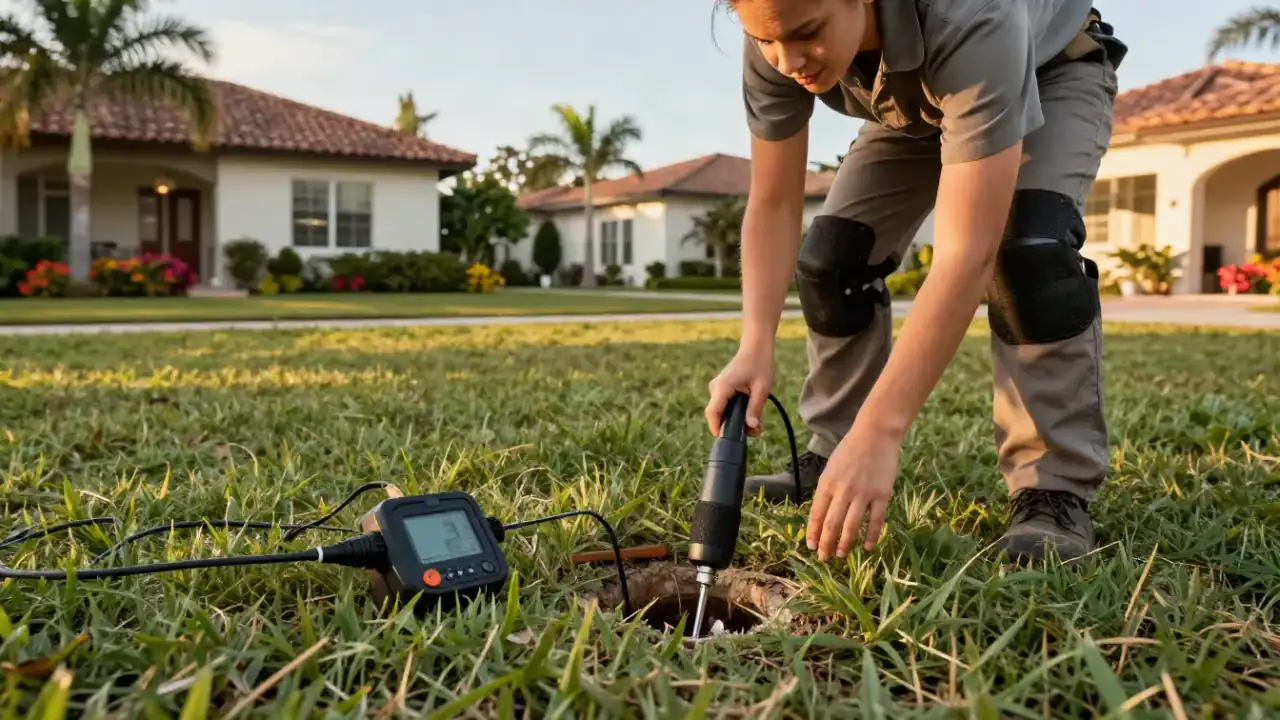
If your pool is losing more than 2 inches of water in 24 hours, it is leaking, not evaporating. Evaporation in Wellington typically accounts for 1/8 to 1/4 inch per day, and anything beyond that points to a structural or plumbing leak. This guide walks you through the bucket test, the daily loss rate math, and the signs that separate normal evaporation from a leak that needs professional pool leak detection in Wellington, Florida.
We run these tests on pools across Wellington every week, from Olympia to Palm Beach Polo, and the numbers almost always tell the story before we even pull out our acoustic equipment. Here is how to read them yourself.
How Much Water Should a Pool Lose Per Day in Wellington?
A pool in Wellington should lose no more than 1/4 inch of water per day to evaporation during the cooler months, and up to 1/2 inch per day in July and August when humidity drops and temperatures push past 90 degrees. If you are seeing 1 inch or more per day, that is a leak until proven otherwise.
Wellington sits in western Palm Beach County, where the dry season runs from November through April. During those months, humidity can fall below 50 percent, and a 15 mph breeze off the equestrian fields will pull water off your pool surface faster than you might expect. A 400-square-foot pool can lose 50 to 80 gallons per day to evaporation in that kind of weather.
Here is the quick math we use on site:
- Normal evaporation: 1/8 to 1/4 inch per day in winter, 1/4 to 1/2 inch per day in summer.
- Suspect a leak: 1/2 to 1 inch per day, especially if it is consistent regardless of weather.
- Definite leak: More than 1 inch per day, or any loss that continues when the pool is covered or the pump is off.
Measure at the same time every morning, mark the water level on a piece of tape stuck to the tile, and write down the number. Three days of data beats a single reading every time. If you want a second opinion on what those numbers mean, our team handles Pool and Spa Leak Location Wellington FL and can usually tell you within an hour whether you have a leak or just a dry spell.
The Bucket Test: The Simplest Way to Separate Evaporation From a Leak
The bucket test is a swimming pool evaporation test that compares the water loss in a bucket sitting on your pool step to the water loss in the pool itself. If the pool drops faster than the bucket, you have a leak. If they drop at the same rate, you are looking at evaporation.
Here is how to run it correctly:
- Fill a 5-gallon bucket with pool water until it is 2 to 3 inches from the top.
- Set the bucket on the top step of your pool, making sure it is stable and the water inside is level with the pool water outside.
- Mark both water levels with a piece of tape or a grease pencil.
- Run the pool pump on its normal schedule for 24 hours.
- Measure the drop in both the bucket and the pool.
If the pool drops 1/4 inch and the bucket drops 1/4 inch, that is evaporation. If the pool drops 3/4 inch and the bucket drops 1/4 inch, you are losing 1/2 inch per day to a leak. That is the number that matters.
Run the test twice, on two separate days, before you draw a conclusion. Wind, sun exposure, and splash from kids or dogs can throw off a single reading. If the second test confirms the gap, it is time to bring in equipment that can hear or see the leak. We do this every day for homeowners across Leak Detection in Olympia and the surrounding Wellington communities, and the bucket test is still the first thing we ask about.
Signs Your Pool Is Leaking, Not Evaporating, in Wellington
Signs your pool is leaking not evaporating in Wellington show up in places beyond the water line. The water level is the headline, but the supporting evidence is usually sitting right there on your deck, your pump, or your landscaping.
Watch for these:
- Soggy spots in the yard between the pool and the equipment pad, especially in the same place day after day.
- Craacking or lifting deck pavers near the pool edge or along the plumbing run.
- Air in the pump basket or a pump that loses prime overnight.
- Higher-than-normal water bills if your pool has an auto-fill tied to the house supply.
- Algae blooms that keep returning in the same corner, which often means fresh water is diluting your chemicals.
- Loose tile or a dropping skimmer throat where the deck meets the pool shell.
One sign alone might be weather. Two or three together almost always mean a leak. If your auto-fill is running constantly and your water bill jumped, that is a plumbing problem, not evaporation, and it is worth treating it like one. We also handle Water Meter and High Water Bill Investigation Wellington FL for homeowners who want to know exactly where that water is going before they start digging.
What Causes Pool Leaks in Wellington Homes?
Pool leaks in Wellington come from four main places: the shell, the plumbing, the equipment pad, and the fittings. The cause usually depends on the age of the pool and the soil it sits on.
Most of Wellington sits on sandy soil and limestone, which shifts with our wet and dry seasons. That movement is hard on pool shells and the plumbing underneath them. A pool built in the 1990s in Leak Detection in Binks Forest may have original PVC lines that have been flexing for 30 years.
Here is what we find most often:
- Skimmer and return line cracks from ground movement or age.
- Light niche leaks where the conduit seal has failed.
- Main drain leaks at the hydrostatic valve or the drain pot.
- Pump and filter housing leaks that drip onto the pad and look like rain runoff.
- Auto-fill valve failures that let water run continuously into the pool and out through a hidden leak.
If your pool has a spa, check the spa check valve and the spillway. A failed check valve can drain water from the spa into the pool overnight, which looks like a leak but is actually a plumbing crossover. We sort those out as part of our pool leak detection Wellington service, and it is one of the fastest fixes we make.
Common Mistakes Homeowners Make When Diagnosing a Pool Leak
The biggest mistake homeowners make is adding water and waiting. Every day you top off a leaking pool, you are adding hundreds of gallons to the soil around your deck, and that water has to go somewhere.
Other mistakes we see regularly:
- Testing only on a windy day. Wind can double your evaporation rate and mask a small leak.
- Running the bucket test with the pump off. The pump circulates water and changes the pressure on the plumbing. Run it on its normal schedule.
- Assuming a dye test is conclusive. Dye works on some leaks and misses others entirely, especially underground.
- Ignoring the equipment pad. A slow drip from a pump seal can lose 50 gallons a day and never show up as a wet spot.
- Waiting until the pool is half empty. By then, the leak has often undermined the deck or eroded the backfill.
If you have already topped off the pool twice this month, stop and run the bucket test. Then call us. We would rather find a small leak now than a collapsed deck later.
When to Call a Professional for Pool Leak Detection in Wellington, Florida
Call a professional when the bucket test shows a gap of 1/4 inch or more per day, or when you have topped off the pool more than twice in a month. Those two numbers are the clearest signal that evaporation is not the whole story.
We use acoustic listening equipment, pressure testing, and dye testing to pinpoint the leak without draining your pool or tearing up the deck. Most residential pool leak detections in Wellington take 60 to 90 minutes, and we tell you what we found before we leave. Typical 2026 pricing for a residential pool leak detection in this area runs $350 to $550, and that fee is often credited toward the repair if you have us fix it.
If your pool is losing water and you are not sure why, give Wellington Leak Detection a call. We serve all of Wellington and the surrounding communities, including Leak Detection in Palm Beach Polo and the neighborhoods along South Shore Boulevard. We find the leak, explain the fix, and get your pool back to normal.
Frequently Asked Questions
How do I know if my pool is leaking or just evaporating in Wellington FL?
Run the bucket test for 24 hours with the pump running. If the pool drops more than the bucket by 1/4 inch or more, it is leaking. If both drop at the same rate, it is evaporation.
How much evaporation is normal for a pool in Wellington?
Expect 1/8 to 1/4 inch per day in the dry season and up to 1/2 inch per day in summer. Anything over 1/2 inch per day consistently is worth investigating.
What is the bucket test for pool leaks in Wellington?
It is a 24-hour comparison test. You place a bucket of pool water on the step, mark both levels, and measure the difference. A gap between the two means a leak.
Who does pool leak detection in Wellington?
Wellington Leak Detection handles residential and commercial pool leak location across Wellington and nearby communities. We use acoustic and pressure testing to find leaks without draining the pool.
How much water should a pool lose per day in Wellington?
No more than 1/4 inch in winter and 1/2 inch in summer. If you are losing 1 inch or more per day, treat it as a leak and get it checked.
Get Help With Leak Detection in Wellington
If your pool is losing water faster than the bucket, we can find the leak and tell you exactly what it will take to fix it. Call Wellington Leak Detection at (561) 760-4218 and we will schedule a pool leak detection at your Wellington home.