Hearing Running Water When Everything Is Off
That running water sound with every fixture off is rarely your imagination. Here is what causes it in Wellington homes and how to track down the leak fast.
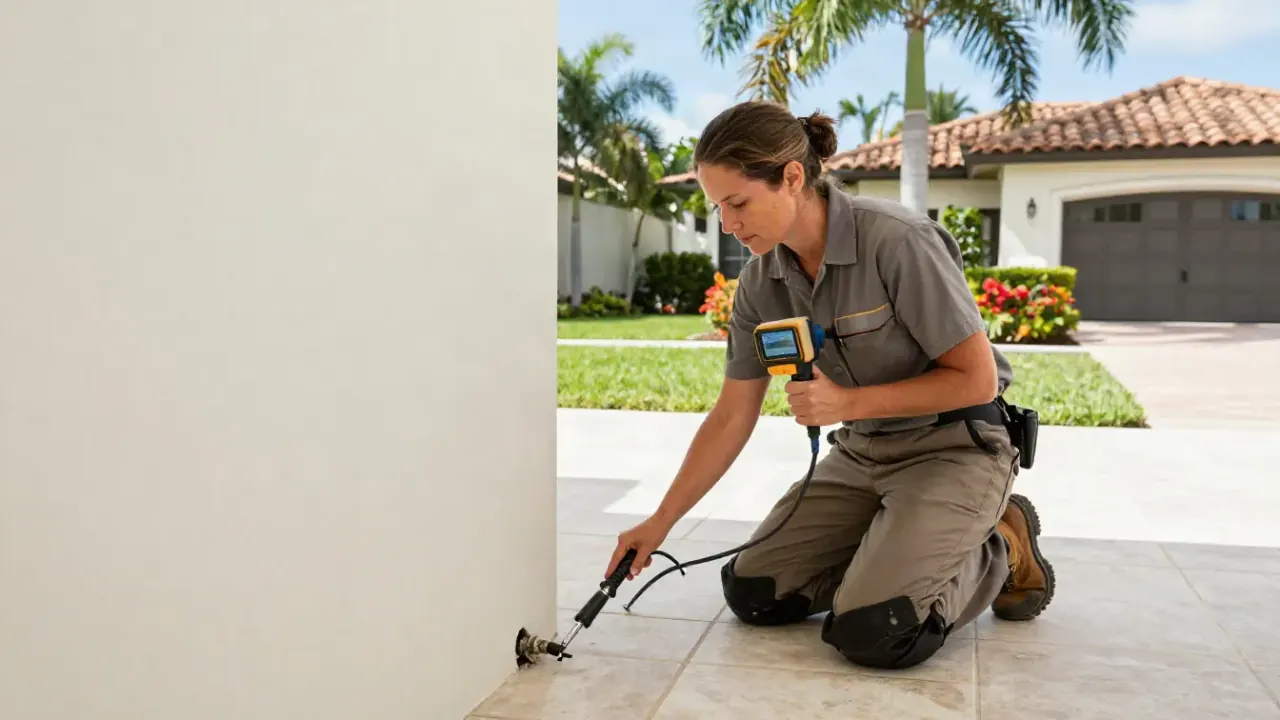
If you hear running water when every faucet, shower, and appliance is off, you almost certainly have a hidden water leak somewhere on your property. The sound is pressurized water escaping a pipe, a toilet fill valve, an irrigation line, or a pool line, and it will not stop on its own. In Wellington, where most homes sit on slab foundations and run irrigation year-round, that noise is one of the earliest and most reliable warning signs we get called about.
Below we walk through what actually causes the sound, how to narrow down the source in about fifteen minutes, and when it is time to bring in a leak detection team. We do this work every day across Wellington and the surrounding villages, and the pattern is remarkably consistent.
Why You Hear Running Water When Everything Is Off in Wellington FL
Hearing running water when everything is off in Wellington FL is a pressure problem, not a drainage problem. Your home's water supply sits under roughly 50 to 70 PSI of constant pressure, and any break in that sealed system pushes water out through the opening. That movement of water through a pinhole, a cracked fitting, or a failed valve is what your ear picks up as a hiss, a trickle, or a steady rush.
The reason it is so noticeable at night is simple: ambient noise drops, and the leak does not. A leak the size of a pencil tip can waste 30 to 60 gallons a day, and a larger one can push that past 200 gallons. Wellington homes on municipal water see that show up as a bill spike within one or two billing cycles.
There is an important distinction to make early. A running water sound that continues with all fixtures closed points to the pressurized supply side. A gurgling or draining sound points to the drain or sewer side. If the noise is a steady hiss, you are chasing a supply leak. If it is intermittent and tied to fixtures elsewhere in the house, you are likely hearing drain activity. Water Meter and High Water Bill Investigation Wellington FL is the service that separates those two possibilities cleanly, because the meter tells us exactly how much water is moving when nothing should be.
The Usual Suspects Behind a Running Water Sound in Your Walls
A running water sound in walls almost always traces back to one of six sources, and in our experience the order below matches how often we find each one.
- Toilet fill valve or flapper. The single most common cause. A worn flapper lets tank water bleed into the bowl continuously. You hear a faint trickle, and the fill valve cycles on and off all night.
- Slab leak under the foundation. Wellington's slab-on-grade construction means supply lines run through or under concrete. A pinhole there produces a steady hiss and often a warm spot on the floor.
- Irrigation zone valve stuck open. A zone valve that fails to close keeps a sprinkler circuit pressurized. You hear water moving near the exterior wall or the valve box.
- Water service line leak between the meter and the house. This one runs underground and can go unnoticed for months until the bill arrives.
- Pool or spa line leak. With roughly 1,200+ homes in Wellington carrying a pool, auto-fill lines and return plumbing are frequent culprits.
- Water heater or pressure relief valve. A failing T&P valve or a cracked dip tube produces a hiss near the unit and a damp patch in the pan.
If your home is in one of the equestrian communities off South Shore Boulevard, the irrigation and pool categories jump to the top of the list. We see this constantly in Leak Detection in Palm Beach Polo, where large lots mean long runs of buried irrigation and pool plumbing that see constant pressure.
Why Do I Hear Water Running in My Walls in Wellington?
Water running in your walls in Wellington is usually a supply line or a drain stack, and the location of the sound narrows it down fast. A hiss behind a bathroom wall is almost always a supply line or a toilet valve. A gurgle behind a shared wall is a drain stack or a vent issue.
Wellington's climate adds a wrinkle. Our water is hard, running 250 to 300 mg/L of calcium carbonate in many areas, and hard water eats through valve seats, flappers, and copper fittings faster than soft water does. A flapper that would last five years in a cooler climate often fails in three here. The same mineral buildup narrows pipes and raises pressure at the fixture, which makes small leaks louder.
Age matters too. Homes built in the 1980s and 1990s across neighborhoods like Greenview Shores and Southfields are now hitting the window where original copper and polybutylene supply lines start pinhole leaking. If your house is 30 years old and you hear a new sound, that history is worth mentioning to whoever you hire.
How to Find a Hidden Leak Making a Running Water Sound in Wellington
You can narrow down a hidden leak in about fifteen minutes with nothing but your ears, your hands, and your water meter. Here is the sequence we recommend to homeowners before they call us.
Step 1: Confirm the sound is continuous
Shut off every fixture, unplug the ice maker, and turn off the irrigation controller at the breaker. Wait ten minutes. If the sound persists, it is a supply-side leak. If it stops, the culprit is one of the fixtures or the irrigation system.
Step 2: Read the water meter
Find your meter box near the street, lift the lid, and note the reading. Wait thirty minutes with nothing running and read it again. Any movement at all means water is escaping somewhere between the meter and the house. That is the single most reliable test you can run.
Step 3: Isolate the house from the irrigation
Most Wellington homes have a separate shutoff for the irrigation main. Close it and recheck the meter. If the needle stops, the leak is in the sprinkler system. If it keeps moving, the leak is inside the home or on the service line.
Step 4: Listen at the walls and floor
Press a glass against the wall or floor and listen. You will often hear the leak louder at one spot than another. Warm spots on a slab floor point to a hot-water line leak; cool spots point to cold water.
If the meter test points underground, the next step is professional acoustic and thermal locating. That is where Water Service Line Leak Location Wellington FL comes in. We use acoustic listening discs and tracer gas to pinpoint the break within a foot or two, so the excavation stays small.
What to Watch Out For Before You Call Anyone
The biggest mistake homeowners make is waiting. A small supply leak rarely stays small. Under a slab, pressurized water erodes soil, undermines the concrete, and eventually produces a crack you can see. By the time a floor feels spongy or a baseboard swells, the repair has grown from a pipe fix into a flooring and foundation job.
Second mistake: turning the water back on to "test" after you have shut it off. If you have isolated a leak, leave the main off until someone looks at it. Cycling pressure on and off through a failing pipe makes the break worse.
Third mistake: assuming the sound is the neighbor's problem. In attached villas and townhomes, a leak in a shared wall can absolutely present as noise in your unit. If you are in a community like Leak Detection in Isles at Wellington, where units share plumbing chases, it is worth knocking on the adjoining door before you tear into your own wall.
Finally, watch for these companion signs. Any one of them alongside the sound moves you from "maybe" to "definitely":
- Water bill up more than 20 percent with no change in usage
- Damp or discolored drywall, baseboards, or cabinet bottoms
- A musty smell in one room that does not clear
- Warm spots on a tile or concrete floor
- Pool losing more than a quarter inch of water per day
- Irrigation zone that stays wet long after the cycle ends
When to Call a Professional
Call a professional the moment the meter test shows movement with everything off, or the sound has lasted more than 24 hours. Those two signals mean water is actively escaping, and every day you wait adds cost.
Wellington Leak Detection handles the full range of these calls. We locate the leak first with acoustic, thermal, and pressure testing, then repair it, then verify the line holds pressure before we leave. For slab situations we use Slab Leak Location Wellington FL to find the break without breaking up half your floor. For irrigation and pool lines, we trace the run and isolate the failed section so you are not replacing pipe you do not need to.
Typical 2026 pricing in this area runs $250 to $450 for a standard leak location, and $150 to $400 for the repair itself depending on access and pipe material. Slab and underground jobs run higher because of excavation. We give you the number before we start, and it does not change.
Frequently Asked Questions
Why do I hear running water when everything is off in Wellington FL?
You hear it because pressurized water is escaping a leak in your supply system, a toilet fill valve, or an irrigation line. The sound continues because the leak does not stop when fixtures do. In Wellington, slab construction and year-round irrigation make both causes common.
Does hearing running water mean I have a leak in Wellington?
Yes, in nearly every case. A continuous running water sound with all fixtures off means water is moving somewhere it should not. The only exception is drain noise from a neighbor in an attached unit, which is why the meter test matters.
How do I find the source of running water sound in my house?
Shut off every fixture and the irrigation, then watch your water meter for 30 minutes. Any movement means a supply leak. Then isolate the irrigation main and listen at walls and floors with a glass. That narrows the source to a zone before a pro arrives.
Who should I call for a hidden water leak in Wellington?
Call a dedicated leak detection company, not a general handyman. Locating a hidden leak requires acoustic listening equipment, thermal imaging, and pressure testing. Wellington Leak Detection handles location and repair in one visit, usually same day.
How much does leak detection cost in Wellington in 2026?
Expect $250 to $450 for a standard residential leak location in 2026. Slab, underground, and commercial jobs run higher. The repair is quoted separately once we know the pipe material and access, and we confirm the number before any work starts.
Get Help with Leak Detection in Wellington
If you are hearing running water when everything is off, we can find it and fix it, usually the same day you call. Our team covers Wellington and the surrounding villages with acoustic locating, thermal imaging, and full repair.
Call Wellington Leak Detection at (561) 760-4218 and we will get a technician out to trace the sound to its source.